Outdoor Concrete Countertops for BC Kitchens & BBQ
Outdoor Kitchen Planning Guide · British Columbia

Outdoor Concrete Countertops for BC Kitchens & BBQs

Outdoor concrete countertops provide a durable, highly customizable surface for built-in BBQs, sinks and outdoor kitchens. Before choosing concrete, however, it is important to understand how fabrication, weather exposure, cutouts, finishes, sealing and installation affect the finished countertop.

Are Concrete Countertops a Good Choice for an Outdoor Kitchen?

Outdoor concrete countertops are particularly well suited to projects that require custom dimensions, integrated appliance openings or an architectural appearance that standard countertop materials cannot easily provide.

Precast concrete can be fabricated around built-in BBQs, sinks, faucets and other outdoor-kitchen components while coordinating with nearby concrete pavers, masonry, retaining walls and landscape features. For additional examples of Sanderson's custom precast concrete countertops , visit the main countertop product page.

The material is also highly adaptable from a design perspective. Thickness, edge profiles, integral colour, exposed aggregate and other finish details can be developed around the architecture of the outdoor space rather than forcing the project into predetermined countertop sizes.

But concrete should not be treated as a maintenance-free surface. Exterior concrete countertops in British Columbia may be exposed to prolonged rain, wet-dry cycles, direct sunlight and, depending on the project location, freezing temperatures. Drainage, support, fabrication details, sealing and ongoing care therefore need to be considered during planning.

Weather Exposure Covered and fully exposed outdoor kitchens can require different detailing and maintenance strategies.
Appliance Coordination BBQ, sink and appliance specifications should be confirmed before countertop fabrication.
Natural Concrete Character Tonal variation, pores and gradual patina should be expected as part of the material.
Fabrication Method

Precast vs. Site Poured Concrete Countertops for Outdoor Kitchens

Both methods use concrete, but the fabrication process is very different. For an outdoor kitchen, the choice between precast concrete countertops and site-poured concrete affects finish control, appliance coordination, site disruption, handling and installation planning.

Custom precast concrete countertop fabricated by Sanderson Concrete Precast Concrete

Precast Concrete Countertops

A precast countertop is formed, cast and finished away from the project site before being transported to the outdoor kitchen for installation.

Fabricating the countertop in a shop environment gives the fabricator controlled access to forms, finishing equipment, aggregates and other production resources. Dimensions, appliance openings, edge details and seam locations are coordinated before casting.

  • Fabricated from approved drawings and confirmed dimensions.
  • BBQ, sink and appliance openings can be incorporated into the cast.
  • Finishing occurs before the countertop reaches the project.
  • Large pieces require advance planning for weight, lifting and access.
  • Piece sizes and seam locations can be coordinated around the outdoor kitchen layout.
Concrete outdoor kitchen countertop showing appliance integration Site-Poured Concrete

Site-Poured Concrete Countertops

With site-poured construction, the formwork is assembled at the outdoor kitchen and the concrete is placed, cured and initially finished at the project.

This approach avoids transporting a completed countertop slab, but more of the casting operation occurs within the finished or partially finished outdoor space. Access, weather, formwork and construction sequencing therefore become important considerations.

  • Forming and concrete placement occur directly at the project.
  • Finished slabs do not need to be transported from a fabrication shop.
  • Site conditions and weather can influence the casting process.
  • The contractor must coordinate formwork, finishing and curing on site.
  • It can be practical when the complete installation process is being managed by the site contractor.

Key Differences to Consider

The better method depends on project geometry, site access, finish expectations, installation responsibilities and how far the outdoor kitchen has progressed when fabrication begins.

Planning Factor Precast Concrete Site-Poured Concrete
Fabrication Formed, cast and finished in a fabrication shop before delivery to the outdoor kitchen. Formed, poured, cured and initially finished directly at the project.
Appliance Cutouts Openings are coordinated from drawings and confirmed equipment specifications before casting. Openings are incorporated into the on-site formwork based on project conditions and equipment requirements.
Site Disruption Most casting and finishing work occurs away from the finished outdoor space. Formwork, concrete placement, finishing and curing take place at the outdoor kitchen.
Weather Exposure During Fabrication Fabrication occurs in a shop environment before the finished pieces are transported to site. Construction conditions at the project may influence forming, placement and curing.
Handling Weight, lifting points, transportation, access and piece size must be planned before fabrication. Finished slabs do not require transportation, although concrete and forming materials must reach the installation area.
Seams Joint locations can be deliberately coordinated with appliance openings, corners and transportation limits. The number and location of construction joints depend on the forming and placement strategy.
Best Fit Custom outdoor kitchens that benefit from coordinated shop fabrication, detailed finishes and planned installation. Projects where on-site casting is practical and the contractor controls the complete forming and finishing process.

Which Method Is Better for an Outdoor Kitchen?

Neither method is automatically better for every project. For concrete countertops in an outdoor kitchen, the decision should be based on the countertop geometry, finish expectations, appliance layout, site access and installation plan.

Precast fabrication is particularly useful when a project requires carefully coordinated openings, custom finishes or multiple pieces that need to be fabricated before arriving at the site. The important step is making these decisions early enough that the countertop, appliances and supporting structure can be coordinated together.

Custom Fabrication

Planning BBQ, Sink and Appliance Cutouts in Outdoor Concrete Countertops

One of the main advantages of custom precast fabrication is the ability to coordinate BBQ, sink and appliance cutouts directly into the countertop design. The key is confirming equipment information before fabrication begins.

Custom outdoor concrete countertop fabricated around outdoor cooking equipment in Vancouver BC
Appliance openings should be coordinated from confirmed manufacturer specifications before the countertop is cast.

Why Exact Appliance Information Matters

A custom countertop can be designed around built-in grills, sinks, faucets, access doors, refrigerators and other outdoor-kitchen equipment. However, the rough opening should not be estimated only from the advertised appliance size.

For example, a product described as a 30-inch BBQ does not necessarily require a 30-inch countertop opening. Manufacturer-specific installation dimensions, ventilation requirements and clearances can differ substantially between models.

Before shop drawings are finalized, the fabricator should receive the exact appliance make and model together with the current installation documentation.

  • Exact BBQ, grill or pizza-oven model
  • Sink type and manufacturer dimensions
  • Faucet and accessory-hole locations
  • Ventilation and required service access
  • Manufacturer clearance requirements
  • Location of seams near appliance openings
  • Edge distances around narrow concrete sections
Do not finalize openings from assumed dimensions.

Appliance requirements should be verified before the countertop drawings are approved. Changes after casting can be difficult, expensive or technically impractical.

1

Confirm the Equipment

Identify the exact BBQ, sink, faucet and appliance models rather than working from generic size descriptions.

2

Review Manufacturer Drawings

Use current cutout dimensions, ventilation requirements, clearances and mounting instructions from the equipment manufacturer.

3

Coordinate the Support

Confirm cabinet, masonry or steel support locations so openings and countertop bearing areas do not conflict.

4

Approve Before Casting

Final dimensions, appliance locations and seam positions should be reviewed before the countertop enters fabrication.

What Should Be Prepared Before Fabrication?

The most efficient projects begin with coordinated information. Dimensioned plans, appliance documentation and support details help reduce uncertainty before the countertop is cast and make it easier to determine practical piece sizes, joints and installation requirements.

Finish & Design Options

Outdoor Concrete Countertop Finishes and Colours

The finish of an outdoor concrete countertop affects more than appearance. Texture, aggregate exposure, colour, edge details and sheen all influence how the surface integrates with the surrounding outdoor kitchen and how normal use becomes visible over time.

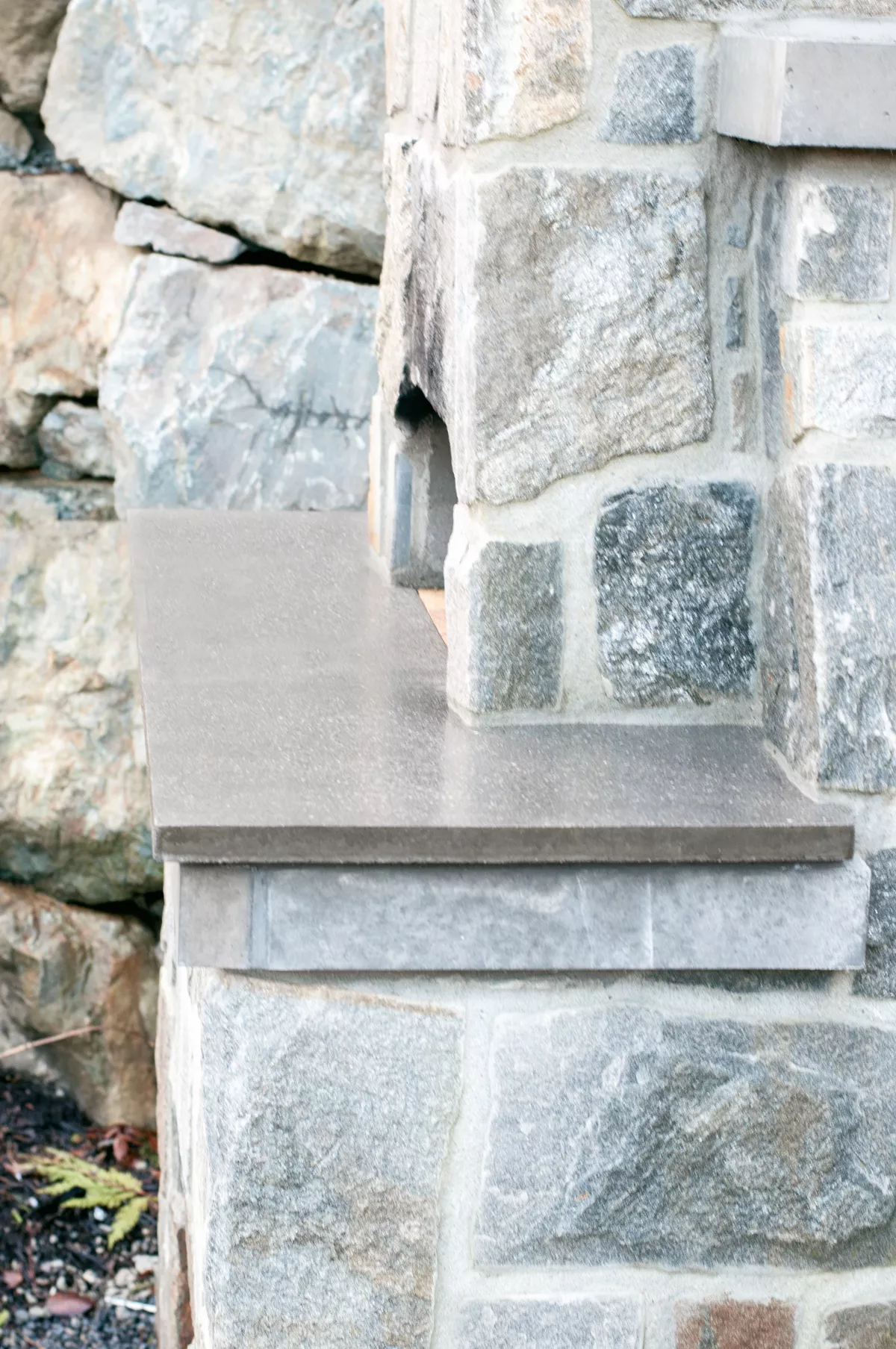
Custom precast concrete countertop showing architectural finish and natural surface variation
Custom Concrete Finish

Concrete Is Designed as Part of the Architecture

Colour, aggregate exposure, thickness and edge details can be coordinated with masonry, paving, cabinetry and other outdoor materials.

See the Moscone concrete countertop project for an example of custom architectural precast concrete fabrication.

Choosing the Right Finish for an Outdoor Kitchen

Outdoor concrete countertop finishes can range from relatively smooth, restrained surfaces to highly visual exposed aggregate finishes. The right choice depends on the overall design, desired texture and the level of natural variation the project team expects to see.

Unlike manufactured sheet materials, concrete is a cast mineral product. Differences in cement, aggregate, pigment, finishing and curing can create subtle tonal movement and surface variation. Sanderson's concrete finishes page provides additional examples of finish directions that can be considered during the design process.

Samples are therefore useful for establishing a design direction, but they should not be interpreted as a guarantee that every finished piece will look completely identical.

Polished / Ground

Grinding can create a refined surface and reveal selected aggregate depending on the specified level of exposure.

Exposed Aggregate

Aggregate or decorative materials become a stronger visual part of the surface and can coordinate with surrounding concrete work.

Smooth Formed

A quieter finish emphasizes mass, geometry and edge details while retaining the natural character of cast concrete.

Integral Colour

Pigment can shift the countertop away from standard grey and help coordinate it with masonry, pavers or architectural finishes.

Expect natural variation.

Concrete is not intended to look like a perfectly uniform synthetic surface. Small pores, tonal changes and subtle differences between pieces are part of the material's visual character.

Design Detail

Colour

Integral pigments can support warm, neutral or darker palettes while still allowing natural concrete variation to remain visible.

Design Detail

Aggregate

Aggregate selection and exposure can create subtle texture or become a major visual feature of the countertop.

Design Detail

Edge Profiles

Edge shape and countertop thickness influence the apparent weight and architectural character of the finished piece.

Design Detail

Surface Sheen

Finish and sealer choices can influence reflectivity, colour depth and how the countertop appears in direct outdoor light.

Review Samples in the Context of the Outdoor Space

Whenever possible, finish samples should be reviewed alongside the project's masonry, paving, cabinetry and other materials. Exterior lighting can make colours and aggregate appear different than they do indoors, so the surrounding environment should be part of the selection process.

Outdoor Performance

Sealing, Staining, Weather Exposure and Natural Patina

Sealing outdoor concrete countertops can help reduce absorption and make routine cleaning easier, but no sealer makes concrete completely immune to stains, scratches, heat, moisture or long-term weathering.

What Does a Sealer Actually Do?

A sealer is one component of the countertop system. Depending on the product, it can help reduce liquid penetration, improve cleanability and influence sheen or colour depth.

However, outdoor concrete countertops are still working surfaces. Cooking oils, wine, acidic foods, standing water, metal objects and abrasive use can affect the appearance if spills or residue remain on the surface.

Sealer selection should therefore reflect the expected use of the outdoor kitchen, environmental exposure, desired appearance and the maintenance the owner is willing to perform.

  • Wipe spills rather than allowing them to remain on the surface.
  • Use cleaners compatible with the installed sealer system.
  • Avoid cutting directly on the countertop.
  • Use appropriate protection for hot cookware and cooking equipment.
  • Prevent wet covers, debris or standing water from remaining trapped.
  • Include the countertop in seasonal outdoor-kitchen inspections.
Sealed does not mean stain-proof.

A properly selected sealer can improve resistance and cleanability, but ongoing care still matters. Concrete should be treated as a natural architectural material rather than a completely maintenance-free synthetic surface.

Polished outdoor precast concrete countertop showing natural surface character in Surrey BC
Finish and sealer decisions should reflect the expected use, environmental exposure and maintenance expectations of the project.
Performance Factor

Food & Cooking

Oils, wine, sauces and acidic ingredients can affect the surface if spills are left untreated for long periods.

Performance Factor

Moisture

Outdoor countertops should be detailed so water can drain rather than remain trapped against the surface, joints or adjacent materials.

Performance Factor

Heat & UV

Direct sunlight and cooking equipment create demanding conditions, so finish and sealer recommendations should suit the actual installation.

Performance Factor

Seasonal Use

Outdoor kitchens used year-round may experience different moisture, cleaning and maintenance conditions than covered seasonal installations.

How Do Outdoor Concrete Countertops Perform in BC Weather?

British Columbia does not present one single exposure condition. A covered countertop in Metro Vancouver may experience a very different environment from a fully exposed installation in the Interior or at higher elevation.

Rain exposure, freeze-thaw conditions, direct sunlight, drainage and proximity to coastal environments should therefore be discussed during project planning rather than assuming the same specification works everywhere.

Natural Patina Is Part of Concrete's Character

Exterior concrete can develop subtle colour changes, wear patterns and surface character as it ages. For many architectural projects, that evolving appearance is part of the material's appeal. Clients who expect a permanently unchanged and perfectly uniform surface should establish that expectation before selecting concrete.

Frequently Asked Questions

Outdoor Concrete Countertop FAQs

These are some of the most common planning questions for custom outdoor concrete countertops, BBQ counters and outdoor kitchen projects in British Columbia.

Do outdoor concrete countertops need to be sealed?

Sealing is generally recommended to reduce absorption and improve cleanability. The appropriate sealer depends on exposure, expected use, desired appearance and maintenance requirements. Even a sealed concrete countertop can develop staining or natural patina over time.

Can BBQ and sink cutouts be precast into the countertop?

Yes. Custom openings can be incorporated into precast fabrication when the design is suitable. Exact appliance models, manufacturer dimensions, ventilation requirements, support conditions and clearances should be confirmed before final shop drawings are approved.

Will an outdoor concrete countertop stain?

Concrete can stain, particularly when cooking oils, wine, acidic foods or other liquids remain on the surface. An appropriate sealer, prompt cleaning and regular maintenance can reduce staining, but no system makes the material completely stain-proof.

Can the colour and aggregate be customized?

Yes. Integral colour and selected aggregates can be used to develop a custom appearance. Because concrete is a cast mineral material, samples should be viewed as a finish range rather than a guarantee that every section will be completely uniform.

How do concrete countertops perform in BC weather?

Performance depends on project location, weather exposure, drainage, support, fabrication details, sealer and maintenance. A fully exposed countertop in an Interior freeze-thaw environment may require different considerations than a covered outdoor kitchen in Metro Vancouver.

How heavy are precast concrete countertops?

Weight varies according to dimensions, thickness, geometry and the specific fabrication system. Countertop supports, access routes, lifting methods and installation equipment should therefore be reviewed before fabrication rather than after the pieces are completed.

What information should I provide for an outdoor countertop quote?

Provide the project location, approximate dimensions or drawings, outdoor kitchen layout, exact BBQ and sink information, preferred finish, support details, site-access information and desired project timeline. Photos and plan files can also help clarify the scope.

Planning a Custom Outdoor Concrete Countertop?

If you have an outdoor kitchen, built-in BBQ or custom countertop project in British Columbia, send Sanderson Concrete your layout, approximate dimensions and appliance information.

The more project-specific information you provide, the easier it is to review fabrication feasibility, piece sizes, cutouts, finish direction and installation requirements.

Explore Sanderson Concrete Countertops →
Project Inquiry

Request a Quote or Send Your Outdoor Kitchen Layout

Tell us what you are planning and provide as much project information as you currently have.

Preliminary dimensions are useful for an initial review. Final fabrication dimensions and appliance information should be verified later in the project process.

.